www.triptotemples.com | India’s No. 1 Kailash Yatra Agency
Top Kailash Yatra Packages


The UNESCO World Heritage Site, The Valley of Flowers, Open From June 1, 2025
Published : 07-Jun-2025 03:31:08 PM
Share This News :
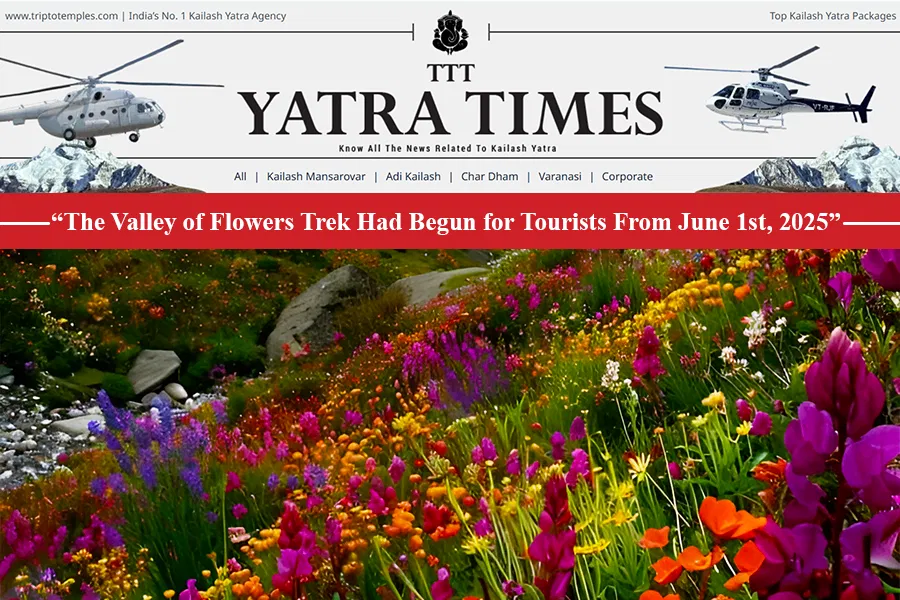
The highly awaited Valley of Flowers National Park began its 2025 season on June 1, marking the start of a spectacular year for nature enthusiasts and trekkers, and is expected to remain open until October 31, 2025. On the day of the Valley of Flowers 2025 opening, this peaceful alpine destination welcomed its first 83 visitors at 7 AM. Registration for the peak period from June 15 to 30 has already been completed, indicating strong early interest from domestic and international tourists seeking to experience this UNESCO World Heritage site.
Located in Chamoli district within the Nanda Devi Biosphere Reserve, the Valley of Flowers sits majestically at an elevation exceeding 9,000 feet above sea level. The valley represents one of Uttarakhand tourism’s crown jewels, drawing visitors from across the globe to witness its extraordinary biodiversity and pristine Himalayan wildflowers.
Contextually, the Valley of Flowers was discovered in 1931, British mountaineer and botanist Frank S. Smythe accidentally stumbled into the valley while conducting an expedition on Mount Kamet. His subsequent documentation and promotion of the valley’s extraordinary beauty brought international attention to this remote Himalayan location. Recognizing its exceptional universal value, UNESCO designated the Valley of Flowers as a World Heritage Site in 1982, cementing its status as one of India’s most significant natural treasures.
The Valley of Flowers houses an impressive collection of over 600 plant species, creating one of the most diverse high-altitude ecosystems in the world. Notable flora includes Aster, Delphinium, Lilium, the rare Himalayan Blue Poppy, and Uttarakhand’s state flower, Brahma Kamal. This rich botanical diversity makes the valley a living laboratory for researchers and a spectacle for nature photographers. Beyond its floral wealth, the national park houses crucial habitat for several endangered species such as red foxes, snow leopards, Himalayan black bears, musk deer, and bharal (blue sheep), making it an essential component of wildlife conservation in the region.
The best time to visit is between July and September, which is a peak bloom following the monsoon's arrival. The Valley of Flowers trek begins from Govindghat, with Ghangaria base camp serving as the primary staging point for visitors. From Ghangaria, tourists must complete a 3-kilometer trek on foot to reach the valley, as vehicular access is prohibited to preserve the fragile ecosystem.
Entry permits are mandatory for all visitors, with fees set at Rs 150 for Indian citizens and Rs 600 for foreign nationals. These permits can be obtained through online platforms, streamlining the registration process for Valley of Flowers 2025 visitors.
To maintain the valley’s pristine condition, strict regulations are imposed. Overnight accommodation is not permitted within the park boundaries, and all visitors must exit by 5 PM daily. Accommodation options are available at Ghangaria, where a traveller can find homestays, lodges, and authentic local cuisine prepared by village communities, supporting the local economic development while providing necessary amenities for trekkers. Food and refreshment facilities are not available within the valley, so tourists must carry their provisions. Environmental conservation remains paramount, with visitors required to carry waste bags to ensure zero impact and sustainable tourism. These measures align with sustainable tourism practices essential for preserving this UNESCO World Heritage site for future generations.
The Valley of Flowers forms part of a broader network of Chamoli attractions, including Joshimath, Badrinath Temple, Hemkund Sahib Gurudwara, and the extensive Nanda Devi Biosphere Reserve. This integration allows visitors to experience multiple facets of Uttarakhand’s natural and cultural heritage within a single itinerary.
Given the unpredictable mountain weather conditions, tourists are advised to pack appropriate clothing for varying temperatures and weather patterns. Rain protection equipment is particularly essential during the monsoon season. It is advisable to check the latest weather update before planning a trek. As the trek covers challenging terrain, physically feeble travellers are advised to avoid visiting.
Share This News :
Popular Videos
#IAmShravanKumar
Reach out to us
Have An Enquiry? Write To Us…
Popular Pilgrimage Packages
We Got Featured in the Media















What Yatris Talk About Us

Trip To Temples
India’s No. 1 pilgrimage travel planner with a decade of expertise. We are the one who started the Kailash Aerial Darshan package. Guided by "Har Safar, Bharose Par," we craft safe, comfortable, and spiritually enriching journeys to Kailash Mansarovar, Char Dham, Adi Kailash, Nepal and beyond.
Tour Resources
Trip To Temples Packages
Popular Destinations
Download The App


© 2026 Trip To Temples. All Rights Reserved.
Design & Developed By : Divine Mantra Pvt Ltd